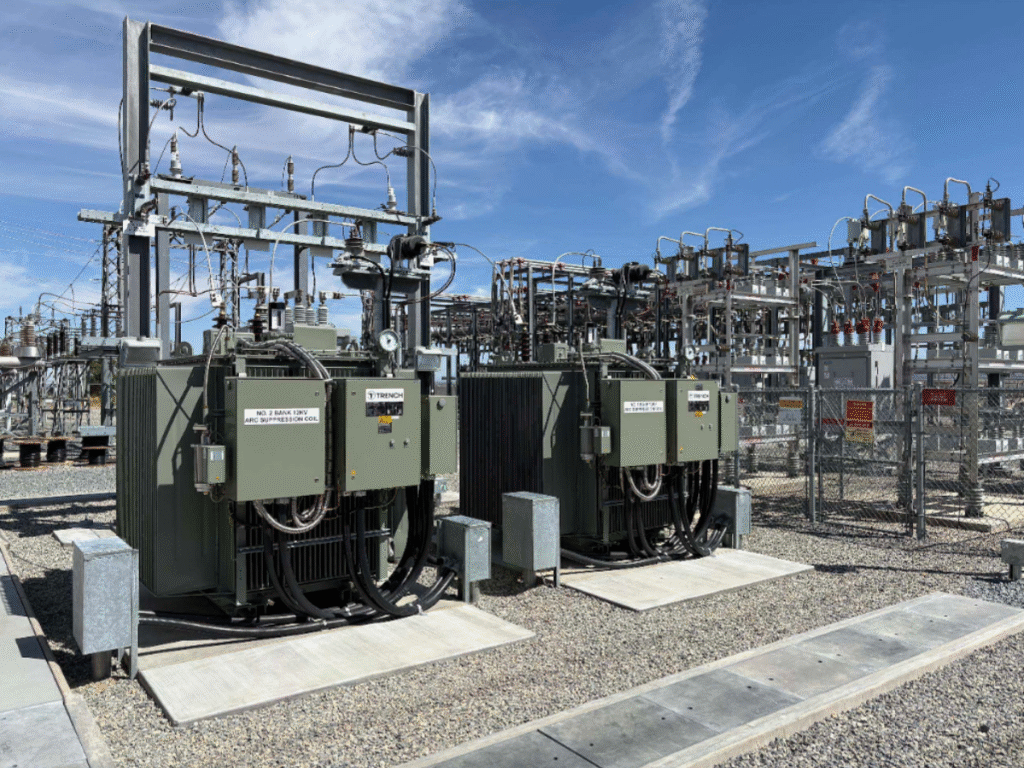
This is where Trench’s ARCC® (Advanced Residual Current Compensation) system comes in: ARCC® is a REFCL system – a Rapid Earth Fault Current Limiter – designed to reduce residual earth-fault current and fault energy in overhead medium-voltage networks. Many medium-voltage networks already use an arc-suppression coil, commonly known as a Petersen coil. It compensates for the capacitive component of the earth-fault current and helps reduce the effects of an earth fault. ARCC® builds on this established principle by combining the coil with advanced power electronics, control technology, and rapid fault detection.
Fast Response at the Fault Location
ARCC® detects earth faults in real time and reduces residual earth-fault current, fault energy, and voltage at the point of occurrence, lowering the risk of an arc that could ignite dry vegetation. While compensation is underway, the EFD500 identifies the affected feeder, enabling targeted intervention. BoostPRO® speeds up compensation, reducing current and voltage more rapidly at the fault location. Where operating conditions permit, the power supply can be maintained without immediate disconnection. ARCC® is available for compensated (resonant-earthed) medium-voltage networks up to 36 kV and supports both 50 Hz and 60 Hz applications.
ARCC® addresses one specific way in which the power network can contribute to fires. It does not replace broader wildfire mitigation measures, but it can complement and be integrated into wider programs. Operational experience demonstrates that it works: ARCC® systems are installed at six sites in Australia. Over the past three years, none of these sites has reported an earth-fault-related ignition.
Trench Austria has worked with Petersen coils since 1954 and develops and manufactures them at its site in Leonding, near Linz, as a core component of the ARCC® system. The first ARCC® systems were delivered to Victoria, Australia, in 2020, followed by a project for one of the major utilities in California. But Trench Austria’s technology is becoming relevant far beyond Australia and the United States. Wherever overhead lines operate in increasingly dry landscapes, utilities must reduce the risk of network faults becoming ignition sources.
Europe’s Growing Relevance
Europe has warmed at roughly twice the global average rate since the 1980s, making it the fastest-warming continent. In 2025, both the area burned by wildfires and fire emissions reached record levels. So far in 2026, severe wildfires have burned more than 650,000 hectares across the European Union. European utilities and network operators are increasingly having to consider how technical faults can contribute to wildfire risk. Recent incidents in Germany and Austria have once again demonstrated that damaged overhead lines can cause fires in nearby vegetation. In southern Spain, investigators considered a fallen power line a possible cause of a major wildfire.
At present, no ARCC® system is installed in Europe. This raises an important question: Are existing protection approaches still sufficient? Or does wildfire mitigation require a broader approach? The challenge concerns not only the protection of forests and landscapes, but also the operation of distribution grids that are safer, more resilient, and better adapted to a changing climate.