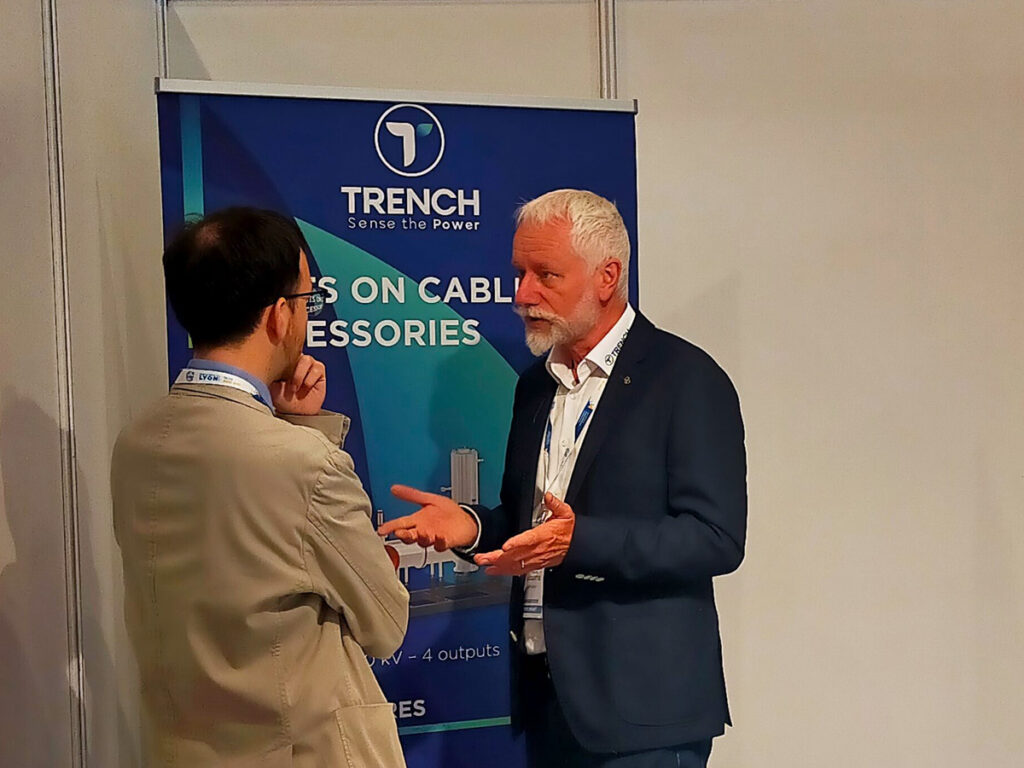
Cable joints are among the most sensitive points in the power grid. As connecting elements between high-voltage cables, they usually remain invisible, but their failure can have massive consequences. “If one part of a 1,000-kilometer line fails, Munich, for example, will no longer receive any power from the North Sea,” explains Pascal Lequitte, project manager at Test Plus at Trench. Experience shows that faulty or inadequately tested joints are among the most common causes of power grid failures.
This is where Test Plus comes in. The Trench department in Bamberg develops test systems for high-voltage components that are precisely tailored to the requirements of manufacturers of high-voltage solutions. Whether special voltage profiles, insulating gas specifications, including alternative gases, or limited space – each test system is individually designed and manufactured.
“Test Plus covers the entire package from engineering and production to system maintenance,” emphasizes department head Jürgen Fischer. The experienced eight-person Test Plus team includes four electrical engineers, one mechanical engineer, and three technicians who perform both mechanical and electrical work. The employees are also deployed worldwide on site at Trench’s international customers.
High Voltage Meets Customization
“Some test systems operate almost continuously,” explains Pascal Lequitte. “Our customers, such as Siemens Energy and Hitachi Energy, use them to test entire series of components under real conditions and at extreme voltages of up to 1.2 million volts. If a component fails the test, it is optimized and retested until everything is right.” This ensures that measuring transformers, switchgear, cable joints, and other high-voltage components can withstand the strict safety requirements over the long term.
The test systems built by Test Plus are usually one-of-a-kind. “We do have customizable standard solutions in our portfolio, but these are rarely sufficient for the special requirements of our customers,” explains Jürgen Fischer. For them, tailor-made testing technologies represent a significant investment.
The systems are designed for a service life of 30 or sometimes even more than 50 years – in a modular design so that they remain adaptable and upgradeable. “We take great care to plan all the details together with the customer first,” says Pascal Lequitte. As the central point of contact for customers, he plays an important role in clarifying the details of the order.
The construction of a complex new testing system comprises the phases of clarifying customer requirements, awarding the contract with budget planning, engineering, material procurement, assembly, and commissioning. “Exotic testing requirements are the norm for us,” says Jürgen Fischer. Whether in Germany, Mexico, Saudi Arabia, or Switzerland, trench systems from Bamberg are in use worldwide.
Custom manufacturing pays off for customers not only in terms of better quality assurance, but also economically: Test Plus testing systems are designed for the future and will meet the requirements of companies in the energy technology sector for a long time to come.
High-Tech for Sustainability
In addition to technical precision, environmental compatibility is also playing an increasingly important role. Trench relies on clean air technologies instead of the climate-damaging insulating gas SF₆ for its new testing systems.